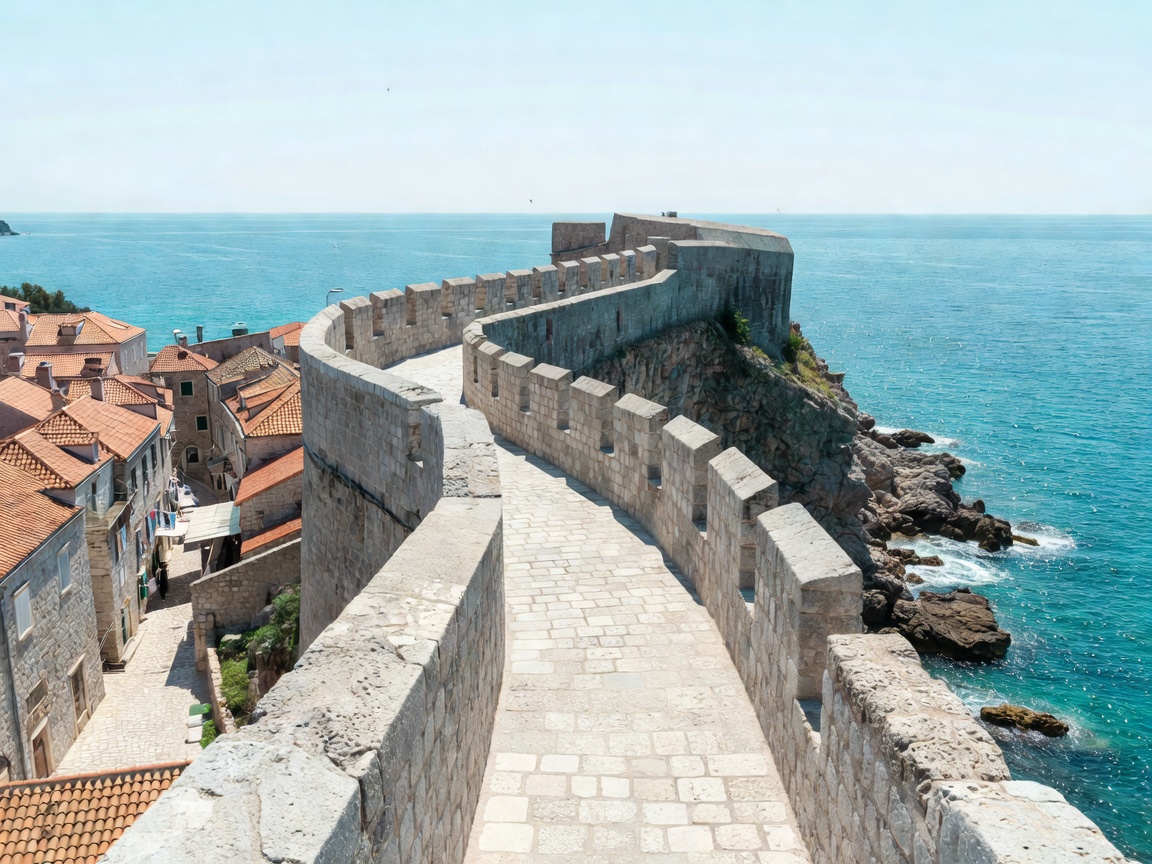
Split: A Living Roman Palace
Split's old centre is built inside and around Diocletian's Palace, a fortified Roman residence whose walls, courtyards and basement halls now hold shops, cafés and homes rather than sitting behind glass as a static ruin. The Peristyle, the palace's central square, is the obvious starting point, ringed by columns and usually busy with people simply sitting on the steps. The cellars beneath the palace, cool and vaulted, are worth ducking into on a hot afternoon.
Outside the old walls, the Riva is Split's palm-lined seafront promenade, and Marjan Hill rises behind the city with wooded paths, viewpoints over the harbour, and small swimming coves on its far side. Split is also Dalmatia's busiest ferry terminal, with regular sailings to Hvar, Brač, and other islands, which makes it a natural base if your plan involves hopping between islands rather than staying in one place.
Zadar: Smaller, Calmer, Coastal
Zadar's old town sits on a narrow peninsula and feels noticeably less crowded than Split or Dubrovnik in the same season. Its best-known feature is the Sea Organ, an installation built into the harbour steps that uses wave motion to produce low, ambient tones — genuinely unusual to hear rather than describe. Nearby, the Greeting to the Sun installation is a circular arrangement of glass panels that stores solar energy through the day and lights up after dark. Both were designed by the same local architect and have become the main reason many visitors add Zadar to their route.
Zadar also has real Roman remains of its own — a forum, and the Church of St. Donatus, a rotunda built partly from recycled Roman stone. Sunset over the harbour is a genuine local draw, with visitors gathering along the waterfront most evenings in season; whether or not it's objectively the best sunset in Europe (a claim you'll hear repeated locally) is a matter of taste, but it's a reliably good one.
Split vs. Zadar: Which Base Suits You?
Choose Split if...
You want the biggest ferry network for island-hopping, more nightlife and restaurant variety, and don't mind more visible crowds in the historic core during summer.
Choose Zadar if...
You'd rather have a calmer old town, easy access to Kornati and Paklenica national parks, and don't need Split's scale of ferry connections.
Day Trips From Each City
From Split, Krka National Park's travertine waterfalls are a manageable day trip, as is the island of Brač with its Zlatni Rat beach, or Hvar for a livelier island scene. From Zadar, the Kornati archipelago — a scattered national park of bare limestone islets — is best seen by organised boat trip, and Paklenica National Park inland offers canyon hiking that's a sharp contrast to the coast. Nin, a small salt-producing town near Zadar with its own tiny old core, makes an easy half-day addition.
Getting There
Both cities have their own airports with seasonal European connections, generally busier in summer and thinner in winter. Split is also reachable by train and long-distance bus from Zagreb, a route that takes several hours through inland Croatia. Ferries connect both cities to the islands and, less frequently, to each other along the coast.
Where to Stay
Split Old Town (€€–€€€)
Highest density of restaurants and nightlife, walking distance to the ferry port.
Zadar Peninsula (€–€€)
Compact and walkable, generally better value than equivalent Split old-town lodging.
Practical Tips
- Book inter-island ferries ahead in July and August — popular routes sell out.
- Visit the Sea Organ around sunset for the fullest experience of both installations together.
- Split's cellars beneath the palace are a good midday heat break.
- If choosing one city for a short trip, Split offers more onward connections; Zadar offers more calm.